Community self-defense and preventive punishment
Earth AbidesCommunity self-defense and preventive punishment become an urgent problem for The Tribe when its members believe Charlie may bring disease into their isolated community. With no doctor, no workable prison, and no confidence that banishment would keep him away, four people must decide whether the group can act before further harm occurs. Their unanimous vote for death establishes a stark principle: collective survival may be treated as grounds for punishment in advance, even as Ish recognizes that such power can itself become dangerous.
The limits of ordinary protection
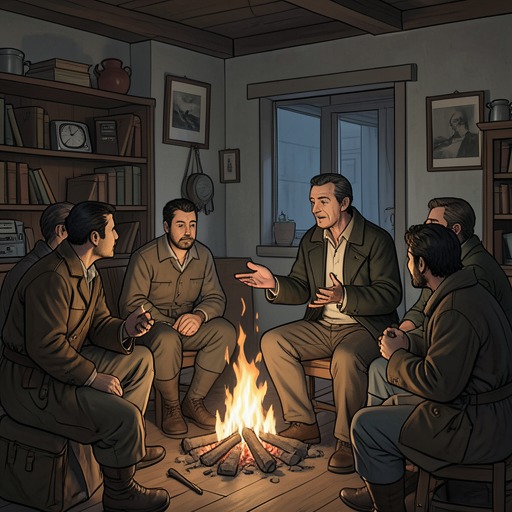
The deliberation begins from a claim that The Tribe has a right and a duty to protect itself. The participants appeal to self-defense as a principle that can apply to a community as well as to an individual. But accepting that right does not settle what action is justified. A warning offers no dependable protection, and punishment after the fact would not prevent the feared disease from spreading. The group has no means of imprisoning Charlie, while constructing and maintaining a jail would impose a continuing burden that the small community could not reliably carry.
Banishment initially seems to offer a less final alternative. The Tribe could take Charlie away and order him to leave; if he returned, the stated penalty would be death. Yet the proposal does not resolve the problem. The group fears he could come back after a time, form ties with younger people, or remain a threat from outside the settlement. The options are therefore not presented as a simple choice between mercy and harshness. Each is measured against the possibility that The Tribe will be unable to protect itself if its decision fails.
Uncertainty, law, and the children
The case is uncertain at its center. Ish insists on fairness by noting that no doctor can establish whether Charlie has a disease. Charlie may have had an illness in the past, or he may be boasting; Ezra, however, thinks Charlie appears unwell and argues that the community cannot safely take the chance. Ish also raises the possibility of treatment, but that suggestion does not resolve the larger question of whether the danger is real or manageable. The decision must be made without the medical knowledge that could distinguish a confirmed threat from suspicion.
George objects that a person cannot be punished for something he has not done. His appeal to law exposes how little the old legal framework can settle in the new circumstances: the others ask what law still applies, and the discussion falters. Em presses the distinction between a system that waits for an offense and a community confronting what it believes may happen next. The presence of children gives that uncertainty an immediate collective weight. For Em, their vulnerability makes the question more than an abstract dispute about legal precedent.
The decision is also shaped by the absence of institutions that once separated judgment from personal fear. The group cannot call on a doctor, a court, or an effective prison. Instead, a handful of people must assess the risk, decide what protection means, and bear responsibility for the result. Their choice is an act of communal self-government, but its small scale does not make it less consequential: the decision concerns both Charlie and the kind of authority The Tribe is prepared to create for itself.
The vote and Ish’s conflict
Em names the alternatives plainly: banishment or death. Ish prepares four paper ballots, one for each participant. His pause over the ballot makes visible the conflict that the practical discussion cannot remove. He considers whether banishment would truly protect the community, and whether his own hesitation might be entangled with anxiety about losing leadership. At the same time, he understands the threat as one that could endanger The Tribe’s continued existence, and he thinks of his children and grandchildren as he changes his vote.
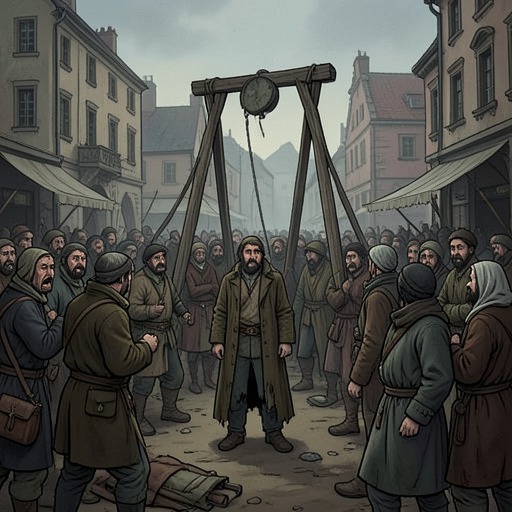
The decision is not represented as uncomplicated justice. Ish distinguishes prevention from retribution: executing someone after a murder would not restore the victim, and punishment meant only as repayment would be vengeance. Yet he fears what the vote may release. By choosing death before Charlie has committed a further offense, The Tribe may revive the beginnings of war, tyranny, and oppression by the majority. Ish starts to erase his choice, stops, and finally gathers the ballots. All four read death.
That unanimity makes the outcome a shared decision rather than Ish’s solitary command, but it does not erase his responsibility or the moral cost he has considered. The procedure gives the community a collective voice; it cannot guarantee that its judgment is correct. The episode therefore holds two propositions in tension: refusing to act may leave the group exposed, while acting preemptively risks turning fear into a license for irreversible punishment.
From emergency action to shared rules
Elsewhere, The Tribe’s response to a failing water supply shows collective action in a less punitive register. The children know nearby streams and springs better than Ish, who still navigates by streets and intersections. They bring water from a spring in five-gallon cans, while older members dig holes and establish outhouses. The work soon brings complaints of blisters and fatigue, and the initial labor does not continue with equal enthusiasm. Still, the water brought back is enough for immediate drinking and cooking, easing the strain. This episode underscores that communal protection also depends on practical knowledge, shared resources, and work suited to changed conditions; it does not make the threat to Charlie equivalent to a shortage of water.
In later years, the community develops a more regular form of collective decision-making. At adult conferences resembling town meetings, decisions bind everyone. Ish presides, but younger men increasingly speak and take action; his hammer can quiet an argument, while his own ideas do not always determine what follows. The distinction matters: authority and shared rules persist, but they are not identical to one person’s control.
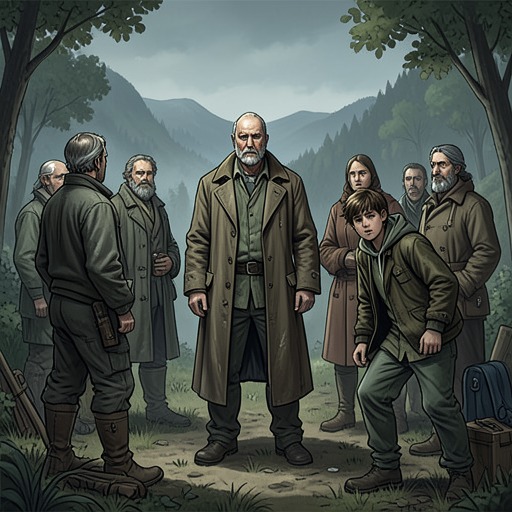
That pattern appears again when The Tribe debates admitting The Others. Ish and Ezra oppose the union, and some younger men share their fear of disease, while others support admission. Em argues that the community cannot preserve life simply by refusing its risks. The vote admits The Others without dissent; the only resulting epidemic mentioned is measles, from which they recover. Together, these decisions show that collective safety is not a fixed policy of exclusion. The Charlie vote remains the most severe instance of preventive action, while the later assembly reflects a community that must repeatedly weigh danger against the conditions needed for life and continuity.